
I tested BabyLoveGrowth on my WordPress website, TechFin2k, to see how useful it is for keyword research, AI content creation, WordPress publishing and backlink building. The platform brings several SEO and content marketing tools together, but I wanted to find out how they actually perform in practice.
In this BabyLoveGrowth review, I’ll share my hands-on experience with its content planning, article generation, WordPress integration and backlink features, including what worked well and what still needs improvement.
Want to Try BabyLoveGrowth?
Explore AI-powered content creation, keyword research, WordPress publishing and SEO tools. Start with a 3-day free trial and explore its features.
Start Your 3-Day Free Trial →Affiliate disclosure: This link is an affiliate link. TechFin2k may earn a commission if you subscribe through it, at no additional cost to you.
BabyLoveGrowth at a Glance
Hands-on evaluation using my WordPress website, TechFin2k.com.
| Platform | BabyLoveGrowth |
| Website Tested | TechFin2k.com |
| Plan Evaluated | Grow Plan |
| Access Period | One Month – Complimentary |
My Testing Status
| Feature | Status |
|---|---|
| AI Content Creation & Planning | Tested |
| WordPress Integration | Tested |
| SEO & Website Health Audit | Tested |
| Backlink Building | Tested |
I tested these features using TechFin2k, starting with the onboarding process and then exploring the platform’s content planning, article generation, WordPress integration and backlink workflow.
1. Getting Started with BabyLoveGrowth: Website Analysis and Business Setup
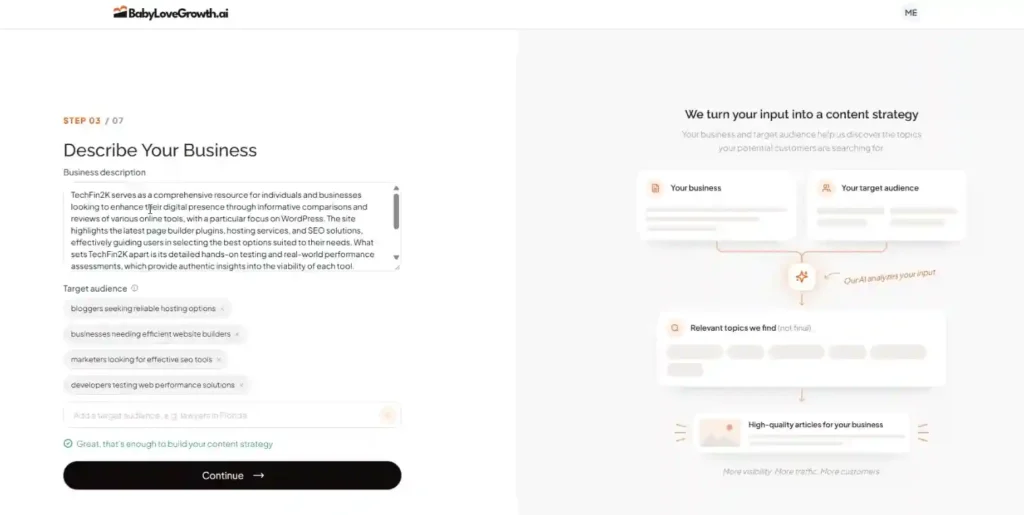
After entering my website URL, BabyLoveGrowth identified it as a WordPress website and moved to the business setup process.
One interesting part of the onboarding was that I didn’t have to write the entire business profile from scratch. BabyLoveGrowth used information from my website to generate an initial business description and suggest relevant target audiences.
For TechFin2k, the generated description recognised the website’s focus on WordPress, web hosting, website builders, SEO solutions and online tools. It also highlighted our hands-on testing and real-world performance assessments as distinguishing features.
The platform suggested these target audience groups:
- Bloggers seeking reliable hosting options
- Businesses needing efficient website builders
- Marketers looking for effective SEO tools
- Developers testing web performance solutions
These suggestions provide a starting point for the platform to understand the business and plan relevant content.
Business details can be edited later
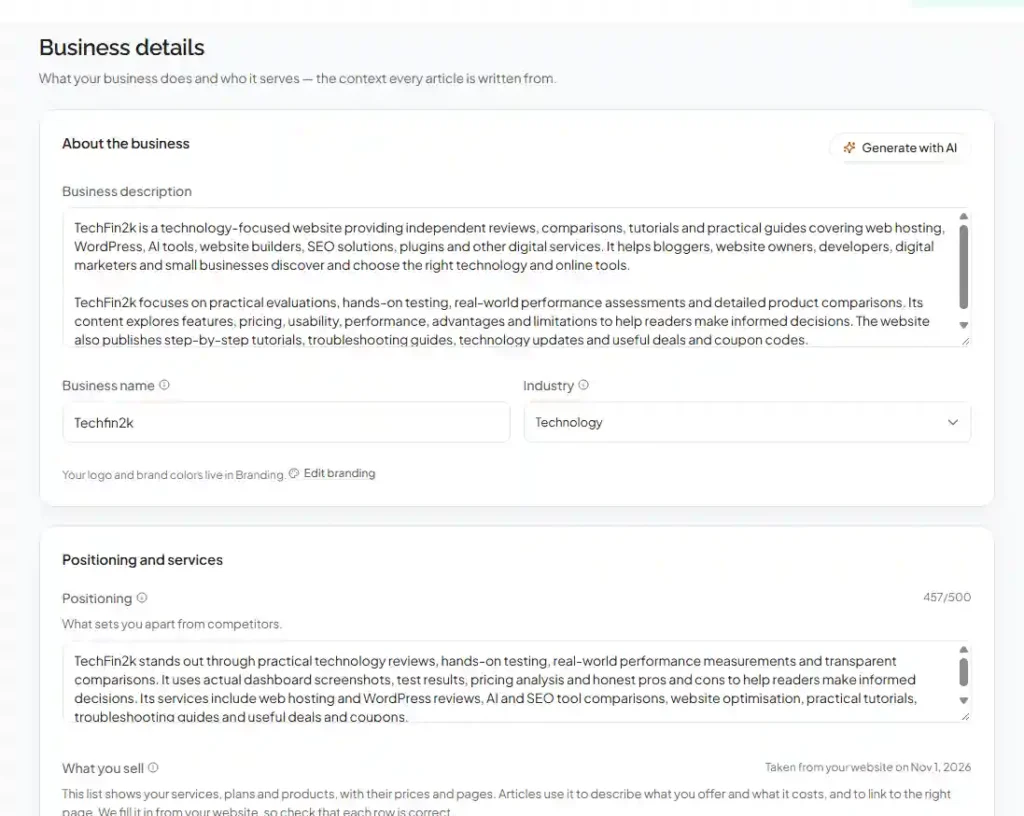
The initial business description isn’t permanently fixed. After completing the setup, I could revisit the Business Details section in the dashboard and make changes.
This section allows users to review and edit their business description, business name, industry, positioning and information about their products or services. There is also a Generate with AI option to create a business description from the website.
This is useful because the business profile acts as context for the articles generated by the platform. Website owners can correct or refine the information rather than relying entirely on the initial automated description.
Branding and brand colours
BabyLoveGrowth also provides branding settings where users can configure their brand identity. Options include uploading a logo and setting primary and secondary brand colours.
For TechFin2k, I selected a blue-based colour identity and used the colour value #2D3748. These branding settings are intended to influence the appearance of generated article images and infographics.
Supported website platforms
Another useful aspect of BabyLoveGrowth is that its publishing integration isn’t limited to self-hosted WordPress websites.
Its platform documentation lists publishing integrations for WordPress, WordPress.com, Shopify, Webflow, Wix and Ghost, along with additional integrations such as Framer, Duda, BigCommerce, GoHighLevel and others. Custom API and webhook options are also available for additional integration possibilities.
I connected and tested the WordPress integration with TechFin2k. The other platform integrations are listed as available options, but I haven’t independently tested each one.
Overall, I found the initial business setup useful because BabyLoveGrowth automatically prepared much of the business context from my existing website, while still allowing me to review and customize it later.
Competitor Selection and Initial SEO Analysis
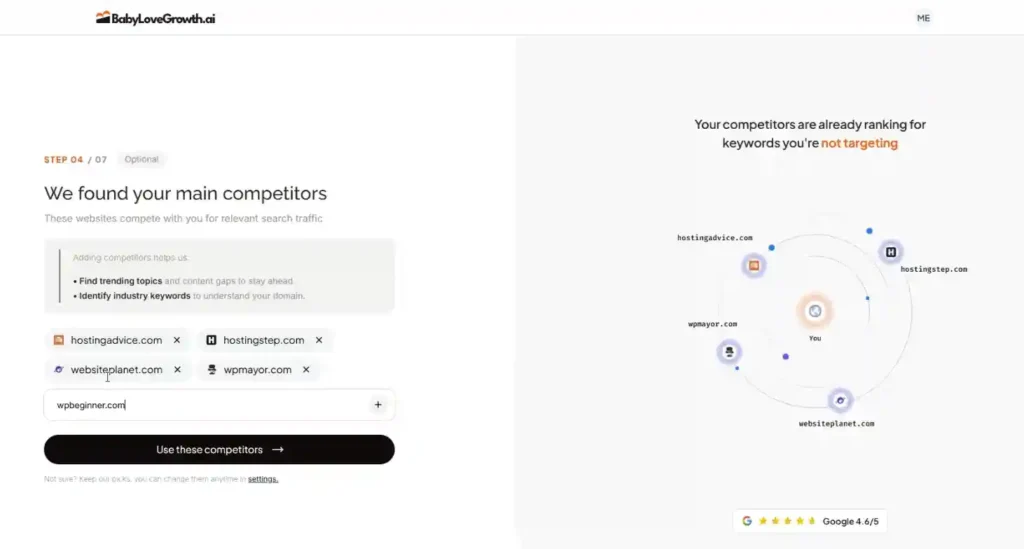
After setting up the business profile, BabyLoveGrowth moved to competitor selection. This was marked as an optional step.
The platform initially suggested four competitors for TechFin2k:
- HostingAdvice
- HostingStep
- Website Planet
- WPMayor
It also provided an option to add other competitor websites. I added WPBeginner and WPKube to the list.
According to BabyLoveGrowth, adding competitors helps identify trending topics, content gaps and industry-related keywords that can be used to develop a content strategy.
During the remaining onboarding steps, the platform also provided four article cover-image style options. I selected the Realistic style with a title for my content preferences.
Account Verification and Initial Website Analysis
After completing the onboarding selections, I proceeded with account registration using my email address and verified the email.
The next step required confirming the subscription and billing details using a credit card. I applied the promotional code provided by Antoine (SEO & GEO Lead, BabyLoveGrowth.AI), which covered one billing cycle with a 100% discount.
Once the account setup was completed, BabyLoveGrowth started preparing a personalized AEO and SEO strategy for TechFin2k.
The dashboard displayed a progress indicator showing that the platform was discovering high-value keywords in my niche and preparing the website strategy. The full initial analysis took approximately 20 minutes in my experience.
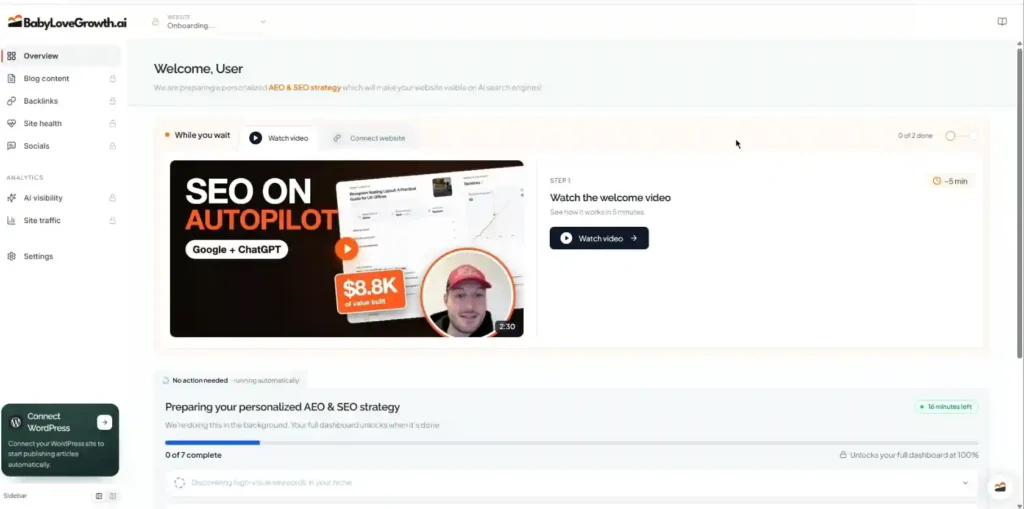
Once the preparation was complete, the dashboard became available for exploring the platform’s different features.
This initial process is worth noting because BabyLoveGrowth analyses the website and builds its content strategy before the user starts working with the main dashboard.
2. AI Content Planning and Keyword Research
After completing the initial website analysis, I explored BabyLoveGrowth’s content planning feature.
The platform prepared a 30-day content calendar for TechFin2k, suggesting topics based on the website’s niche, business information and competitor research.
I monitored the content calendar daily. By the 14th day of my trial, BabyLoveGrowth had generated 14 article entries for TechFin2k. Since my WordPress website was connected to the platform, I could transfer the generated articles to my website. However, they were not published automatically. I selected one article, How to Do Keyword Research for a Blog (Step by Step), reviewed its content, made my own edits and published it manually. The remaining articles were kept as drafts for further review.
Before proceeding with article generation, I also reviewed the suggested topics and keywords to make sure they were relevant to TechFin2k and did not overlap unnecessarily with existing content.
2.1 Reviewing and customizing the content calendar
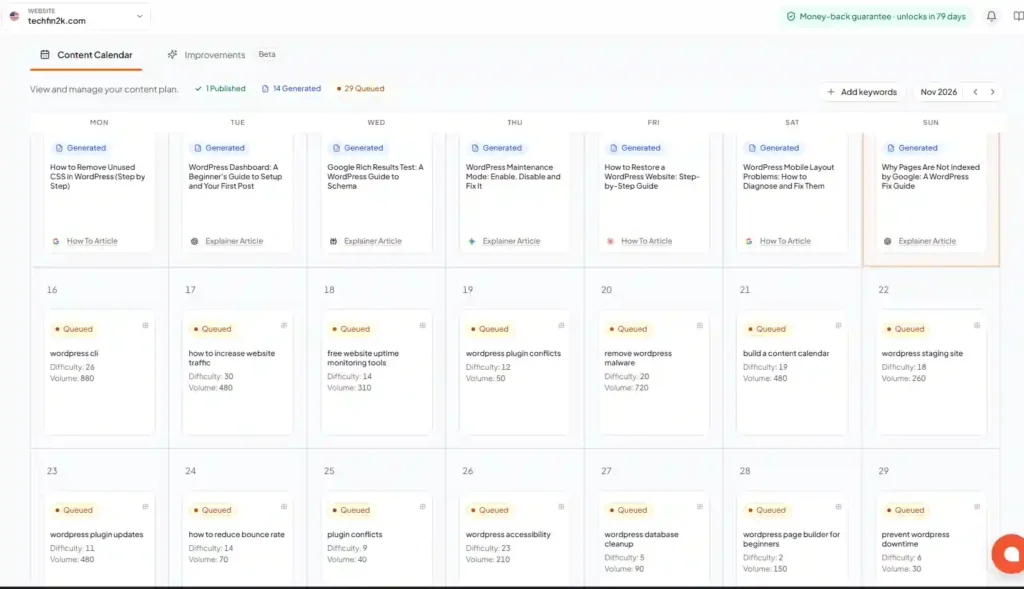
Before accepting the content calendar, I compared its suggested topics with my existing articles and sitemap. Some suggestions were adjusted because they overlapped with topics already covered on TechFin2k. I selected alternative keywords and angles that better matched the intended search intent. This made the calendar a useful starting point, although editorial judgement was still necessary to avoid keyword cannibalization.
This is an important point: the content calendar is a starting point for planning, not something website owners should follow blindly.
2.2 Keyword suggestions, search volume and difficulty
Another useful part of the content planning workflow was keyword selection.
After entering a keyword, BabyLoveGrowth presented different keyword combinations and related topic suggestions. These included estimated monthly search volume and keyword difficulty figures.
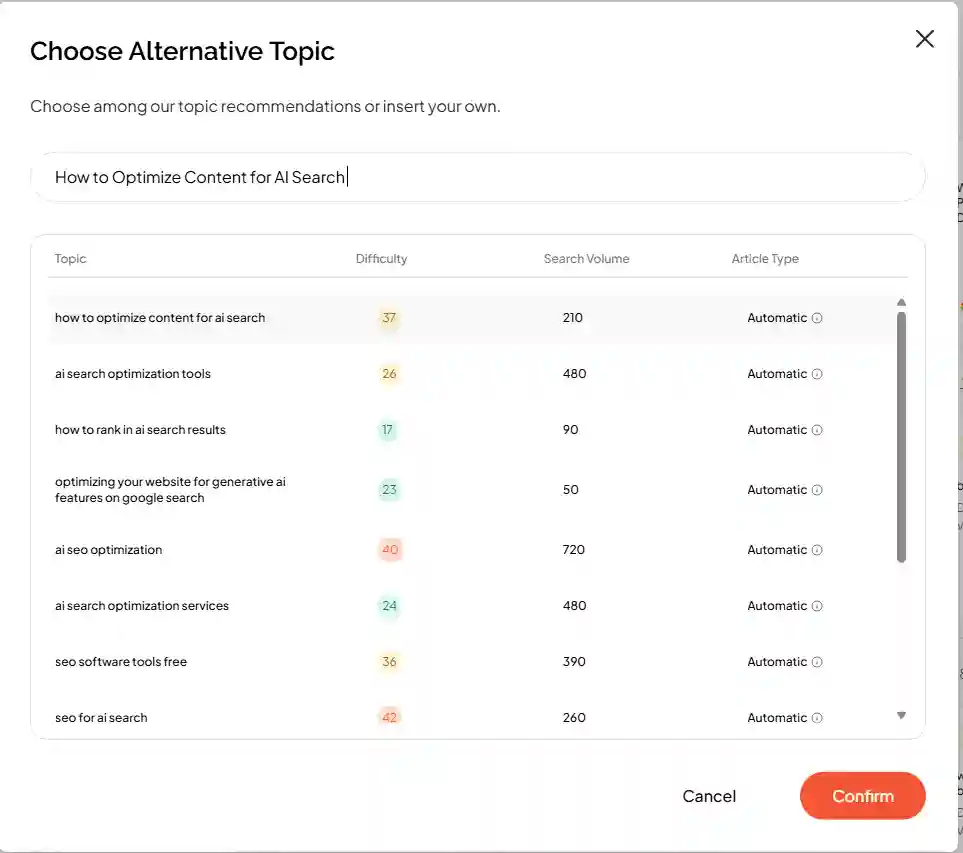
This made it easier to compare possible keyword targets before deciding which one was more appropriate for an article.
I examined the suggested alternatives and sometimes selected a different keyword when it better matched the article’s subject or had a clearer search intent.
I also avoided using different keywords for separate articles when their underlying search intent was essentially the same.
The keyword suggestions were helpful for discovering alternatives, but I still used my own judgement when selecting the final target keyword.
2.3 Custom prompts for article generation
Before generating articles, I also supplied my own instructions and prompts to guide the content creation process.
This was intentional. Different websites have different publishing requirements, writing styles and content formats. A website publishing product reviews, technical tutorials and informational guides may need different instructions for each article type.
For TechFin2k, I wanted the generated content to follow my intended publishing approach rather than rely entirely on generic instructions.
I see the ability to provide custom instructions as a useful part of the workflow, not a disadvantage. It gives website owners more control over the type of content they want to generate.
The next step was to examine how well BabyLoveGrowth followed the selected topics, keywords and instructions when generating an article.
3. AI Article Generation and Content Quality
After completing the content planning and keyword selection, I moved on to evaluate the actual generated article output.
For my first test, I selected How to Do Keyword Research for a Blog.
What did the generated article look like?

BabyLoveGrowth generated a detailed, long-form educational article. The final published version contained approximately 2,705 words and included an introduction, a featured image, a TL;DR summary with five bullet points, and a Table of Contents with 14 entries.
The article covered several aspects of keyword research, including Google Autocomplete, People Also Ask, Google Keyword Planner, search intent, competition analysis, primary keyword selection and performance tracking. It also included a worked example, keyword-planning tables, an FAQ, sources and recommended articles.
One important point about the generated structure is that these elements were not entirely automatic decisions made by the AI. During onboarding, I had configured the writing settings to include specific structural and editorial elements in every article.
These included:
- Author perspective and author name
- Table of Contents
- Recommended Reads
- Sources section and citations
- Competitor mentions when relevant
- Schema Markup (JSON-LD)
- Summary and TL;DR
- Key takeaways, including a one-sentence claim and a Point / Details table
- Internal linking
I had also specifically configured the TL;DR to contain 3–5 bullet points in a highlighted box and enabled automatic internal linking.
Therefore, the generated article’s structure largely reflected the instructions I had provided during onboarding. This is worth highlighting because the platform allows users to establish consistent article-formatting preferences rather than relying entirely on the AI to decide how every article should be structured.
Although the article was comprehensive, my first impression was that it read more like a textbook than a natural blog article. Some sections were lengthy and explained basic concepts in considerable detail. I wanted the final article to be more practical, easier to read and better suited to TechFin2k’s publishing style.
The generated article was therefore a starting point, not something I accepted without review.
Internal and external link suggestions
Another area I examined was the automatic linking functionality.
The published article contained 12 internal links and 9 external links. I removed only one internal link and one external link from the original generated output.
I also noticed how the platform organised some of the links. Four internal links were placed together at the end of the article, as recommended by the platform, while five external links appeared in the Sources section.
This means the platform did more than simply insert links within paragraphs. It also organised internal recommendations and external references into dedicated sections.
Having links suggested automatically can save time, particularly when publishing multiple articles. However, link quantity alone does not determine quality.
I still needed to examine whether the internal links were relevant to the topic and whether the external references supported the claims made in the article. Automatically generated links should not be accepted without checking their relevance and usefulness to readers.
Overall, the linking functionality was useful, although human verification remained necessary.
Editing the generated article using Ask AI
The initial draft required further work before I was comfortable publishing it.
BabyLoveGrowth provides an Ask AI option that allows users to give instructions to modify selected content. This was useful for revising sections rather than rewriting the entire article manually.
The editor also provides four predefined actions:
- Rewrite: Rephrase the selected content.
- Lengthen: Expand a section with additional details.
- Simplify: Make the wording easier to understand.
- Shorten: Reduce unnecessary wording while retaining the main information.
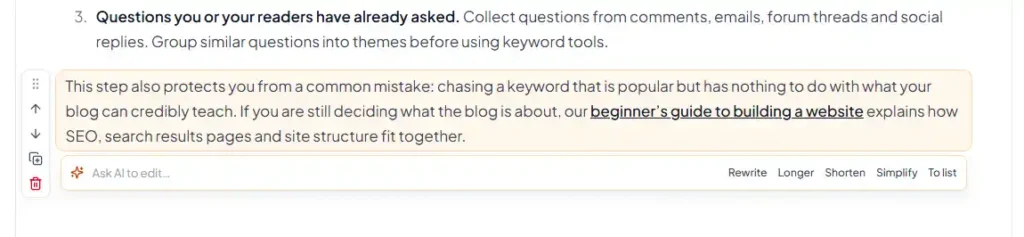
These options provide flexibility, but the user still needs to decide what should change. Simply lengthening an already lengthy article would not necessarily improve it.
In my case, the objective was to retain useful explanations while making the article more focused, practical and appropriate for the TechFin2k audience.
How much editing was actually required?
This was one of the more important parts of my hands-on test.
Although BabyLoveGrowth generated a comprehensive article, I did not consider the initial output ready for publication. I spent approximately 2.5 hours working on the article, although I did not record the exact editing time.
Most of this work involved:
- Fixing and refining tables that needed additional formatting and corrections.
- Regenerating images to obtain more suitable visuals.
- Refining paragraphs where the wording sounded too authoritative without sufficient official evidence.
- Reviewing explanations and improving their accuracy and readability.
- Checking internal links, external references and the overall article structure.
The need to refine authoritative-sounding statements deserves particular attention. An AI-generated article can present information confidently even when the supporting evidence is insufficient. For a technology and informational website, this is something that needs careful editorial verification, particularly when discussing features, specifications or policies that should be supported by official sources.
Consequently, the editing process involved more than polishing the writing. It also required checking the reliability of the information and making sure the article was suitable for publication.
Featured image generation
BabyLoveGrowth also provides an option to generate a featured image using a custom prompt or upload an existing image.
During my testing, I found that image generation was limited to three generations per post. This provides a few opportunities to try different visual options, although I would prefer more flexibility when several image concepts are needed.
The ability to upload an existing image is a useful alternative when users already have a suitable image or prefer to create one using another design tool.
However, image generation should also be considered part of the editorial workflow. The generated visuals may need to be reviewed or regenerated to better match the article’s subject and presentation requirements.
Final result: How much editing was needed?
After reviewing the structure, checking the links, refining the content through Ask AI, fixing tables, regenerating images and making my own corrections, I published the article manually.
You can read the resulting article here:
How to Do Keyword Research for a Blog.
This was an AI-assisted writing process, not an untouched AI-generated article. The final publication reflects both BabyLoveGrowth’s initial output and my own editorial work.
My takeaway: BabyLoveGrowth generated a structured 2,705-word first draft and followed the writing instructions configured during onboarding. However, the article wasn’t ready for publication without further work. I spent approximately 2.5 hours refining the content, correcting tables, regenerating images and checking statements that lacked sufficient supporting evidence.
4. WordPress Integration and Publishing Workflow
After exploring the article generation and editing features, I tested BabyLoveGrowth’s WordPress integration.
Under the publishing section, BabyLoveGrowth provides an option to connect a website. I had already selected WordPress from the available platform options, so I proceeded with that integration.
Connecting TechFin2k to BabyLoveGrowth
The connection process was straightforward. After selecting WordPress, the platform asked whether I was an administrator of the website and requested my website URL.
It then guided me through the following steps:
- Install the BabyLoveGrowth integration plugin on the WordPress website.
- Activate the plugin from the WordPress dashboard.
- Copy the integration key provided after activation.
- Paste the key into BabyLoveGrowth and click Connect My Site.
Once I completed these steps, TechFin2k was successfully connected to BabyLoveGrowth.
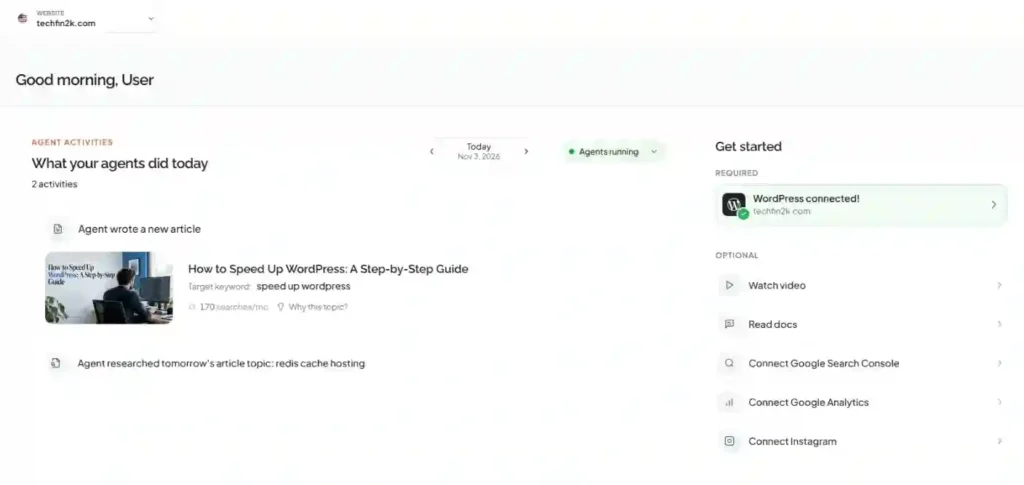
I also noticed an option to enable automatic publishing after connecting the website. However, I deliberately left this option disabled because I wanted to review generated articles and make any necessary corrections before publishing them.
For a technology website like TechFin2k, retaining editorial control is important. Hosting specifications, software features, pricing and technical instructions need to be checked before they reach readers.
When I published the first generated article through BabyLoveGrowth, the content appeared in WordPress as custom HTML rather than individual Gutenberg blocks. Editing the HTML directly in WordPress was difficult, although editing the article inside BabyLoveGrowth was much more convenient.
Since I wanted to retain control of the content even after my BabyLoveGrowth access ended, I used WordPress’s Convert to Blocks option. The first attempt caused an issue, but the conversion worked after two attempts.
I also noticed that the first published article included a promotional link at the end: “Written with BabyLoveGrowth to build website authority.” I manually removed this link.
5. Backlink-Building System and Credit Allocation
BabyLoveGrowth offers a backlink-building feature through a network of more than 4,000 websites. Instead of purchasing backlinks individually, the platform uses a credit-based system in which users earn credits by providing backlinks to other participating websites and spend credits to receive backlinks.
During onboarding, my TechFin2k account received an initial allocation of 100 backlink credits.
How does the credit system work?
According to BabyLoveGrowth, the credit system works as follows:
1. Initial 100 credits
Every website starts with 100 credits, allowing users to receive backlinks immediately.
2. Earn credits
Each backlink you give earns credits equal to your domain rating, up to a maximum of 20 credits per backlink.
3. Spend credits
Each backlink you get costs credits based on the linking site’s domain rating. Your balance can go below zero, and it recovers as you give backlinks.
This is the credit allocation rule published by BabyLoveGrowth. I wanted to test how it worked in practice, particularly how the credits awarded compared with the domain rating displayed for my website.
My first incoming backlinks
When I connected TechFin2k, the backlink dashboard initially displayed the status “Finding opportunities” and indicated that the first backlinks were expected within 3–7 days.
I received three incoming backlinks on November 13, 2026, approximately 10 days after connecting my website.
The three placements were:
| Referring website | Credits spent |
|---|---|
| WillBuckley.com | 27 |
| EntreResource.com | 59 |
| MusicTeacherPros.com | 39 |
| Total | 125 |
The three links appeared in the following articles:
1. WillBuckley – Coupon Affiliate Marketing
The article, Coupon Affiliate Marketing: How It Works and How to Start, included a link using the anchor text “stacked discounts and deals”.
It pointed to our Best Frase.io Coupon Code and Discount for 2024 page.
The subject of coupons and discounts was reasonably related to the source article. However, the destination page promoted an old Frase.io offer that had expired, which reduced its usefulness to readers.
2. EntreResource – Facebook Group Monetization
The article, Facebook Group Monetization, included our link in a section discussing affiliate products that publishers actually use.
The anchor text was “hands-on AI writing tool review”, pointing to our Frase.io article.
Of the three placements, this had the closest contextual connection because the source article discussed recommending affiliate products. However, the destination also contained an old Frase.io promotional offer that was no longer current.
I checked this backlink in Ahrefs and confirmed that it was a dofollow link. Ahrefs showed a Domain Rating (DR) of 58 for EntreResource, while Semrush displayed an Authority Score of 33. These are different third-party metrics and should not be treated as equivalent.
3. MusicTeacherPros – Facebook Conversions API for Music Schools
The article, Facebook Conversions API for Music Schools: A Plain Guide, included a link with the anchor text “AI writing tool review”.
It pointed to the same Frase.io article on TechFin2k.
Although the source article briefly discussed AI writing tools in connection with preparing sales-page content, its main subject was Facebook Conversions API for music schools. Therefore, this placement felt more tangential than the other two.
Are these incoming links dofollow?
I inspected the HTML of the WillBuckley and MusicTeacherPros links. Both used rel="noopener" without nofollow, sponsored or ugc attributes.
I also confirmed the EntreResource link as dofollow through Ahrefs.
Therefore, the three incoming links appeared to be followed links based on the HTML and backlink checks available during my testing.
I could not find the other two referring websites in Ahrefs at the time of checking, even though their articles and links were accessible. This illustrates that a backlink appearing on a live source page does not necessarily mean every backlink-analysis tool will display it immediately.
Testing the credits earned by giving backlinks
I also tested how many credits TechFin2k earned by providing outgoing backlinks.
During my first test, Ahrefs displayed a Domain Rating of 7 for TechFin2k. I temporarily published an article containing two outgoing partner links.
BabyLoveGrowth credited 7 points for each link, adding 14 credits in total.
Subsequently, Ahrefs and the BabyLoveGrowth dashboard both displayed a Domain Rating of 15. I tested the system again using one outgoing partner backlink in another article.
However, the platform awarded only 7 credits instead of 15.
Here is the comparison:
| Test | Domain Rating displayed | Outgoing links | Credits earned |
|---|---|---|---|
| First test | 7 | 2 | 14 |
| Second test | 15 | 1 | 7 |
The second result was difficult to reconcile with the published credit rule. At the time of the second test, my website’s displayed Domain Rating had increased to 15, but the credit awarded for one outgoing link remained 7.
I could not establish from these tests why the credit calculation did not reflect the updated rating. This makes the credit allocation less transparent than I would expect.
Is the credit system balanced?
One aspect I found particularly concerning is the difference between the credits earned and the credits spent.
The published rules cap the credits earned from an outgoing backlink at 20, while the credits spent on an incoming backlink depend on the linking website’s domain rating. The published explanation does not mention a comparable spending cap.
In my test, three incoming backlinks consumed 125 credits, even though the account started with only 100 credits.
The initial allocation was therefore insufficient to cover the cost of those three incoming links, and the balance went negative.
Although the platform allows users to recover a negative balance by giving backlinks, the credit calculation needs to be transparent and reasonably balanced. My own tests also showed that the number of credits awarded did not always correspond to the domain rating displayed on the dashboard.
Reviewing the outgoing backlink suggestions
BabyLoveGrowth also inserted partner backlink suggestions into two AI-generated article drafts:
- Why Pages Are Not Indexed by Google: A WordPress Fix Guide
- How to Optimize Content for AI Search in 2026
Together, these drafts contained five proposed external placements.
I reviewed each destination and the paragraph where the link appeared rather than accepting all the suggestions automatically.
Two placements were unsuitable in their original contexts:
- The Wiki Republic link about Wikipedia and SEO did not support the paragraph discussing canonical tags and duplicate content.
- The MapRank mobile SEO destination could not be reliably verified as the specific guide described in the article.
The other three had a reasonable contextual connection after adjusting the wording:
- LogicBranch’s llms.txt page, described as an example of the company’s own AI and LLM index.
- Opsphere’s Google Search Console integration, described accurately as an integration rather than a general tutorial.
- WarmDoc’s content effectiveness metrics article, which directly complemented the discussion about measuring content performance and conversions.
This review reinforced an important point: a backlink should make sense in the paragraph where it appears and lead to a page that provides the information readers expect. Earning credits should not be the main reason for inserting an external link.
My assessment of the backlink feature
BabyLoveGrowth makes backlink opportunities accessible through a central dashboard and a credit-based arrangement. Receiving three backlinks gave me an opportunity to inspect actual placements, their anchor text, referring domains and link attributes.
However, the experience also highlighted several limitations:
- The first incoming backlinks took approximately 10 days to arrive, compared with the estimated 3–7 days.
- The three incoming placements had different levels of topical relevance and destination-page usefulness.
- The credit cost of receiving backlinks was considerably higher than the credits earned for giving them.
- The credit calculation did not consistently match the domain rating displayed in my tests.
- Automatically suggested placements still required careful editorial review.
There is also an SEO consideration. Google’s link spam policies identify excessive link exchanges and automated link-building services used to manipulate search rankings as examples of link spam.
The fact that participating websites are different on the incoming and outgoing sides does not, by itself, remove this concern. The purpose of the links, their relevance and the overall pattern of link building still matter.
For this reason, I would not recommend accepting every suggested backlink placement simply to accumulate credits. The links should be genuinely useful to readers, and website owners should retain editorial control over what they publish.
My takeaway: BabyLoveGrowth’s backlink feature offers an organised way to discover link opportunities, but the quality of the placements and the transparency of its credit allocation deserve careful consideration. I found the credit imbalance and the difference between the displayed Domain Rating and actual credits awarded particularly important limitations.
6. Pricing and subscription
BabyLoveGrowth offers two main subscription plans: Grow and Scale. Both plans combine AI-powered content creation, backlink building, AI visibility tracking, website audits and social SEO features.
The pricing information I checked showed different rates depending on whether you choose monthly billing or pay annually.
Grow
Content
- 30 branded articles per month
- Writing in one of 50+ languages
- Keyword research and content plan
- Images, infographics, internal links and schema in every article
- Automatic publishing to your website
Backlinks and AI visibility
- High-DR backlinks on autopilot, advertised value of $800+ per month
- 10 AI prompts tracked daily
- Technical site audit with fixes for Google and AI search
Social SEO
- Reddit and Quora posts intended to help your brand get cited by AI
- Weekly Instagram and Facebook posts
- Google Business Profile optimization
Team and support
- Dedicated one-to-one SEO/GEO specialist
- One seat
- Email support
Scale
Content
- 120 branded articles per month
- Content in up to four languages
- Localized keyword research
- Images, infographics, internal links and schema in every article
- Automatic publishing to your website
Backlinks and AI visibility
- Higher-DR backlinks on autopilot, advertised value of $1,600+ per month
- 50 AI prompts tracked daily
- Technical site audit with fixes for Google and AI search
Social SEO
- Reddit and Quora posts intended to help your brand get cited by AI
- Daily Instagram and Facebook posts
- Google Business Profile optimization
Team and support
- Dedicated one-to-one SEO/GEO specialist
- Unlimited seats
- Priority support
Volume discounts for multiple websites
BabyLoveGrowth also advertises automatic volume discounts for customers managing multiple websites. The displayed discount structure was:
| Number of websites | Discount |
|---|---|
| 2–4 sites | 10% off |
| 5–8 sites | 12% off |
| 9–14 sites | 15% off |
| 15+ sites | 20% off – contact the team |
Optional: Bonus backlink credits
In addition to the regular backlink credit system, BabyLoveGrowth offers optional paid bonus credit packages. These are presented as a way to receive additional backlinks without having to publish articles to earn the credits yourself.
The screenshots I captured showed three monthly packages:
| Bonus credits per month | Monthly cost | Approx. backlinks per month | Advertised SEO value |
|---|---|---|---|
| 100 credits | $120 | About 4 | $400–$600 |
| 300 credits | $360 | About 12 | $1,200–$1,800 |
| 600 credits | $720 | About 20 | $2,000–$3,000 |
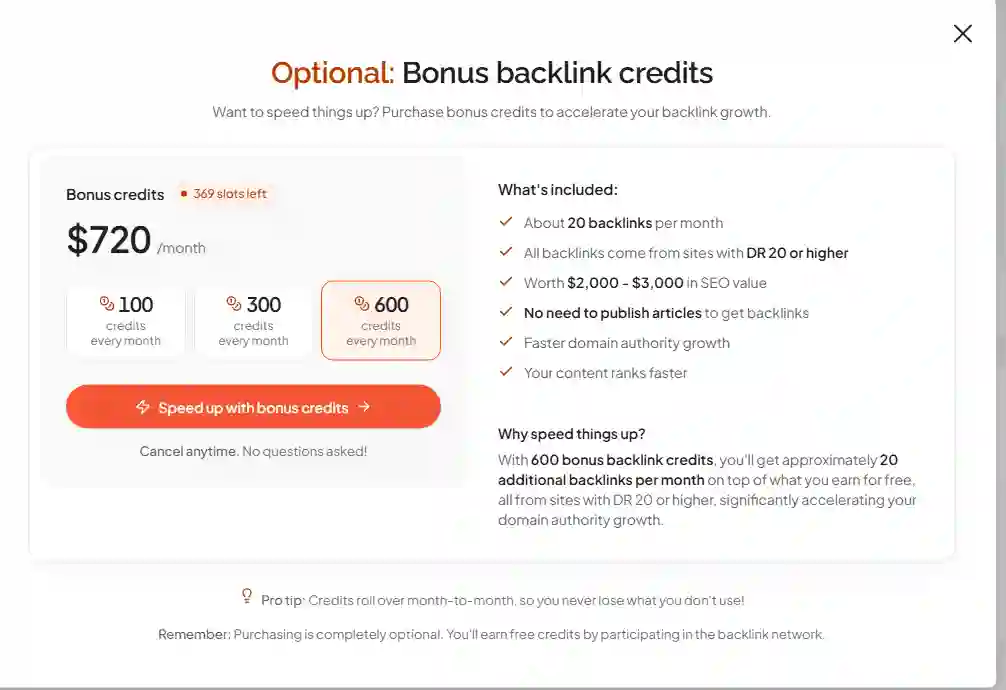
What BabyLoveGrowth advertises with these packages:
- All backlinks come from websites with DR 20 or higher.
- No need to publish articles to receive these additional backlinks.
- Bonus credits roll over from month to month.
- The packages can be cancelled at any time.
The bonus-credit screen also displayed 369 available slots when I checked it. This availability figure may change.
My experience with pricing and credits
I accessed the Grow plan through a promotional arrangement that covered one billing cycle. During my account testing, I also noticed differences between the pricing displays: the public pricing information showed $59 per month with annual billing, while the dashboard displayed $99 per month. The two rates are consistent with the monthly and annual options shown above.
I did not purchase the optional bonus backlink packages. Therefore, I have not independently tested the actual quality of the additional backlinks, the advertised SEO value or any ranking improvements associated with these paid packages.
7. What I liked about BabyLoveGrowth
Based on my hands-on testing, I found several useful features in BabyLoveGrowth.
1. Multiple SEO activities in one platform
Content planning, keyword suggestions, AI article generation, WordPress integration and backlink opportunities are available from one dashboard. This provides a convenient starting point for managing different content and SEO activities without switching between several tools.
2. Competitor selection and content planning
The onboarding process identifies competitors and helps generate a content calendar with suggested topics. I particularly liked being able to review the suggestions and adjust them according to my existing articles, rather than simply accepting every recommendation.
3. Customizable AI article generation
The platform provides writing instructions and content settings that can be configured before generating articles. It also offers editing tools such as rewriting, lengthening, shortening and simplifying selected content.
The Ask AI editing interface is convenient because I could make changes directly within BabyLoveGrowth instead of repeatedly moving text between different applications.
4. WordPress integration
Connecting TechFin2k to BabyLoveGrowth was straightforward. The integration plugin and connection key made the setup process relatively simple.
Once connected, the platform provided an option for automatic publishing. I kept this disabled during my testing so that I could review and correct generated content before publishing.
5. Backlink opportunities through the platform
BabyLoveGrowth provides a credit-based backlink network and automatically incorporates partner links into articles generated through its content workflow. I was able to inspect actual incoming placements and test how the credit system worked.
The dashboard also provides information about referring websites and credit deductions, making the process easier to monitor.
6. Convenient editing before publishing
The ability to edit generated articles directly inside BabyLoveGrowth is useful. The editing interface is easier to work with than editing the underlying HTML after an article has been transferred to WordPress.
However, I preferred converting the published article into Gutenberg blocks so that I could continue editing it independently in WordPress.
8. Limitations and areas to consider
Although BabyLoveGrowth offers several useful features, my testing also revealed some limitations.
1. AI-generated content needs substantial human review
The generated article provided a structured first draft, but it was not ready for publication without editing. I spent approximately 2.5 hours correcting tables, regenerating images and refining statements that needed better supporting evidence.
Website owners should not assume that AI-generated articles can be published without checking their accuracy, usefulness and readability.
2. WordPress publishing and content editing
BabyLoveGrowth successfully connected to WordPress, but the generated article was transferred as custom HTML.
Although editing within BabyLoveGrowth was convenient, making later changes directly in WordPress was more difficult while the content remained HTML. I eventually published the article temporarily and used WordPress’s Convert to Blocks option. It took two attempts before the conversion worked correctly.
I also removed the promotional backlink that BabyLoveGrowth had automatically included at the end of the first published article:
“Written with BabyLoveGrowth to build website authority.”
For website owners who want to retain long-term control over their content, I recommend converting generated HTML into Gutenberg blocks and reviewing the article before making it publicly available.
3. Backlink quality requires editorial judgement
Receiving backlinks through an automated network does not guarantee that every placement will be useful.
In my test, the three incoming backlinks had different levels of contextual relevance. One placement was reasonably relevant, another had a moderate connection, and the third was more tangential.
I also found that some outgoing partner-link suggestions in generated articles required changes to their surrounding paragraphs or destinations.
Website owners should inspect both the source article and the destination page before accepting a placement.
4. Credit allocation needs greater transparency
BabyLoveGrowth explains that outgoing backlinks earn credits based on the website’s domain rating, up to a maximum of 20 credits per link. Incoming backlinks consume credits based on the linking website’s domain rating.
However, my two tests produced different results from what I expected based on the displayed Domain Rating.
When TechFin2k had an Ahrefs DR of 7, two outgoing links earned 14 credits in total. After the displayed DR increased to 15, another outgoing link earned only 7 credits.
This difference makes the credit calculation less transparent, and I would like to see a clearer explanation of how the platform determines the actual credit awarded.
5. AI Visibility currently supports two platforms
BabyLoveGrowth’s AI Visibility feature currently tracks ChatGPT and Claude. In my test, 10 prompts produced 20 responses across these two platforms.
The initial score was 0/100, and none of the 20 responses mentioned TechFin2k.
After contacting support, Antoine confirmed that Gemini tracking is not yet available. This is a current feature limitation rather than an account configuration problem.
6. Some automated SEO recommendations need human judgement
During the website audit, I found recommendations that did not always accurately reflect the purpose of a category or the content assigned to it.
I also encountered an image-alt-text warning for decorative author avatars. Not every automated recommendation necessarily requires implementation, particularly when it would not provide meaningful accessibility benefits.
The website owner still needs to assess whether a suggested change is appropriate.
7. Subscription costs and optional backlink credits
The Grow and Scale plans offer a wide range of features, but their subscription costs may be considerable for individual bloggers and smaller publishers.
BabyLoveGrowth also offers optional paid bonus backlink-credit packages. These are additional expenses, and their advertised backlink quantities and SEO values should not be treated as independently verified performance results.
The pricing and package details are covered separately in the pricing section of this review.
9. Who should consider BabyLoveGrowth?
BabyLoveGrowth may be worth considering for:
- Bloggers and website owners managing WordPress websites who want content planning and SEO tools in one place.
- Content publishers producing multiple articles and looking for assistance with keyword suggestions, article generation and editing.
- Digital marketing agencies managing several websites or client projects.
- Businesses interested in combining content creation, website audits and AI brand-visibility monitoring.
- Publishers exploring backlink opportunities who are prepared to inspect link relevance, destination quality and credit allocation.
However, it may be less suitable for someone who only needs a basic SEO title checker, a simple image compression tool or occasional AI-generated content.
The value of an all-in-one platform depends on how many of its features a website owner will actually use. It is also important to consider the time required for reviewing generated content and checking automated recommendations.
10. Initial verdict: My experience with BabyLoveGrowth so far
My experience with BabyLoveGrowth has been mixed but useful. The platform brings several content and SEO activities together, and some of its features worked well during my testing.
I particularly liked the content planning workflow, competitor selection, AI article editing interface and straightforward WordPress connection.
The backlink feature also provided real placements that I could inspect, rather than just showing suggested opportunities. However, the differences in contextual relevance and the unexplained credit calculation deserve attention.
The biggest practical limitation I encountered was the amount of human editing required before publishing AI-generated content. The article generation process provided a useful starting point, but I would not recommend publishing its output without a thorough editorial review.
Overall, BabyLoveGrowth offers an interesting combination of content creation, WordPress integration and backlink-building features. However, its value depends on the quality of the generated content, the relevance of its backlink placements and the usefulness of its wider SEO tools.
This is my initial assessment based on the content-generation, WordPress integration and backlink features covered in this first part of the review. I will examine the website health audit, AI visibility results, analytics and other platform features separately in Part 2.
Ready to Explore BabyLoveGrowth?
Looking for an integrated platform for AI content creation, SEO planning, website audits and backlink opportunities? Explore BabyLoveGrowth and try its features with a 3-day free trial.
Try BabyLoveGrowth Free for 3 Days →This is an affiliate link. TechFin2k may earn a commission if you purchase a subscription through it, at no additional cost to you.
Testing disclosure: This review is based on my hands-on evaluation of BabyLoveGrowth using the TechFin2k website. I tested the onboarding process, competitor selection, content planning, AI article generation, editing tools, WordPress integration and backlink-building workflow. I also examined the incoming backlink placements and tested the credit system. Pricing and feature descriptions are based on the information displayed by BabyLoveGrowth during my testing. Advertised benefits that I have not independently verified are identified separately.
Enjoying our content?
Make TechFin2K a preferred source on Google to see more of our content when it is relevant to you.
